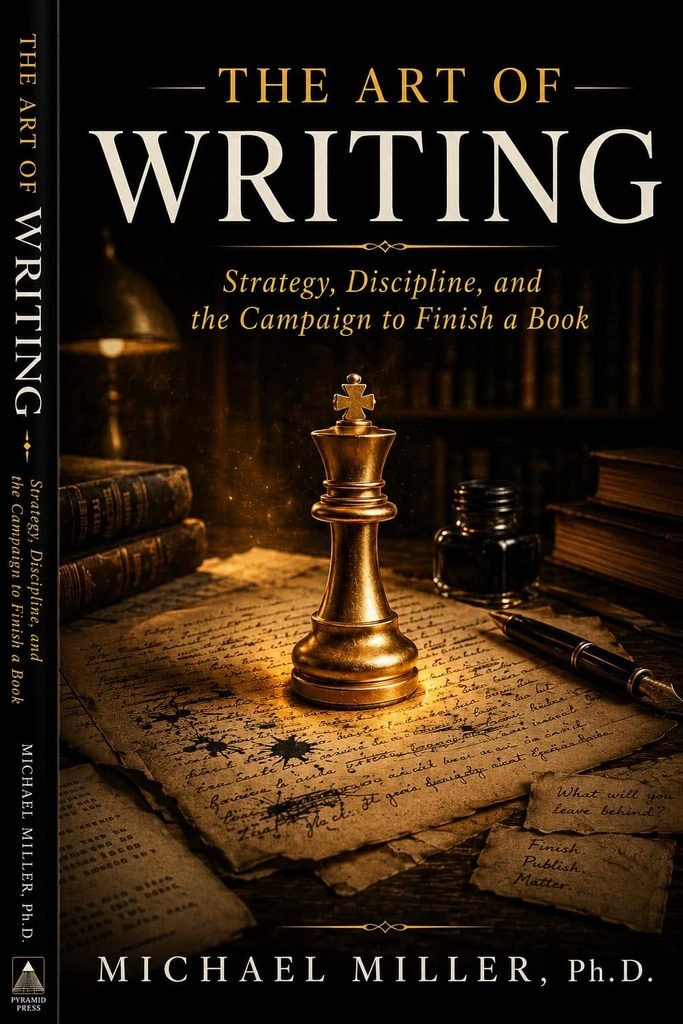
Strategy, Discipline and the Campaign to Finish a Book
What You Will Learn:
♟️ Think Like a Strategist
Approach your writing with a clear plan and purpose.
💡 Turn Ideas Into a Finished Book
Move from inspiration and concept to a completed manuscript.
🛡️ Overcome What Holds You Back
Push through procrastination, self-doubt, and creative resistance.
⏳ Build Daily Writing Discipline
Develop habits that create consistency and momentum.
🎯 Stay Focused
Learn to manage distractions and keep your writing moving forward.
🏁 Finish What You Start
Build the mindset and habits needed to reach the final chapter.

Chapter One
Laying the Plans
A weak purpose produces a weak book.

Chapter Two
Waging War
The discipline required to complete a manuscript.

Chapter Three
Attack the Strategy
The outcome wins the war before the writing begins.

Chapter Four
Tactical Dispositions
The disciplined writer defeats the talented procrastinator every time.
Chapter Five
Energy (Momentum)
Momentum is the most powerful force in writing. Lose it, and the book dies.

Chapter Six
Weak Points and Strong
Write where you have authority. Avoid where you only have opinion.
Chapter Seven
Maneuvering
Confused writing is the mark of a confused author.
Chapter Eight
Variation in Tactics
Monotony weakens writing. Variation keeps the reader advancing.
Chapter Nine
The Army on the March
A book that stops moving is a book that dies.

Chapter Ten
Terrain
Know the terrain of your book. Write where the ground is the strongest.

Chapter Eleven
The Nine Situations
The strategy that begins a book cannot finish it.

Chapter Twelve
Attach by Fire
Revision is the war against weakness.

AI brain light bulb concept. 3D render
Chapter Thirteen
The Use of Spies
A book is tested only by it’s author is not ready for readers.

Author Dr. Michael Miller
Michael Miller, Ph.D., is an author, retired college professor, educator, and entrepreneur who taught English for many years and has written more than twenty published books. Holding an undergraduate degree in English Literature along with three advanced degrees, he is known for his direct, practical approach to communication, discipline, and the writing process.
Drawing from decades of teaching, publishing, and real-world experience, Dr. Miller believes that powerful writing comes not from talent alone, but from clarity, courage, discipline, and persistence. He approaches writing not merely as communication, but as a way of preserving ideas, influencing others, and leaving something behind that outlives its author.
He believes writing is where thought becomes permanent.
In The Art of Writing, Dr. Miller combines practical instruction with real-world insight to help writers sharpen their voice, strengthen their craft, and develop the discipline required to turn ideas into work that endures.